
Reflections on the Shema

The Ten Commandments are a set of moral and religious principles that are considered central to the Judeo-Christian tradition. They were given to Moses by God on Mount Sinai and are recorded in the book of Exodus in the Old Testament of the Bible. These commandments are considered to be the cornerstone of moral and ethical behavior in society, and their importance cannot be overstated. The Ten Commandments are still relevant today, as they provide a guide for living a moral and ethical life. They can be used as a tool for self-reflection and understanding how our actions relate to honoring God and loving our neighbor. Here are some of the ways in which the Ten Commandments are important to society:
1. Provide a moral compass: The Ten Commandments provide a clear moral compass for individuals, outlining what is right and wrong. This helps individuals to make ethical decisions and behave in a way that is consistent with the values of society.
2. Promote social cohesion: The Ten Commandments promote social cohesion by providing a common set of values and beliefs. When people share a common set of moral values, they are more likely to cooperate and work together towards common goals.
3. Encourage respect for authority: The Ten Commandments teach people to respect authority, including parents, teachers, and other leaders in society. This helps to maintain order and prevent chaos.
4. Discourage immoral behavior: The Ten Commandments discourage immoral behavior such as stealing, lying, and murder. By discouraging these behaviors, society is able to maintain law and order, and individuals are able to live in a safe and secure environment.
5. Provide a basis for laws: Many of the laws in modern societies are based on the principles outlined in the Ten Commandments. For example, laws against murder, theft, and perjury are all based on the Ten Commandments.
6. Foster a sense of responsibility: The Ten Commandments encourage individuals to take responsibility for their actions and to be accountable for their behavior. This helps to create a culture of responsibility in which people take ownership of their actions and work towards improving themselves and their communities.
Overall, the Ten Commandments are a critical part of society, providing a clear moral framework and encouraging ethical behavior. They help to promote social cohesion, prevent immoral behavior, and foster a sense of responsibility and accountability.
We live in a world of shortened attention span and while it may be difficult to crunch down the whole of the Bible’s wisdom into a one-minute TikTok video we can try with these two quotes from the New Testament. Jesus told us to: “Be perfect, therefore, as your heavenly Father is perfect.” – Matthew 5:48 NIV
“Love the Lord your God with all your heart and with all your soul and with all your mind. This is the first and greatest commandment. And the second is like it: Love your neighbor as yourself.’ All the Law and the Prophets hang on these two commandments.” - Matthew 22:37-40 NIV; Mark 12:29–31 NIV
These two quotes by Lord Jesus Christ are so simple they may go unnoticed. They may be simple, but they are by no means trivial, as contemplation and deep thinking will reveal they have the power to better the world and unite the three major monotheistic religions: Jewish, Islam, and Christianity. Think for a minute how much better off the world would be if these religions promulgated nothing more than these three commandments. No more wars, no more selfishness, no more differences, no more misinterpretations, bickering, violence, hatred. Isn’t that how the world should be? Isn’t that what religion should strive for?
Let’s give it a little more thought. ‘The Fatherhood of God, the brotherhood of man’, and ‘God our Heavenly Father wants us to be perfect like him’. Let that sink in for a while. Do we need any more laws, rules, guidelines to enlighten us? Are these not enough? How much better would it be if all religions espoused just these simple yet deep divine mandates?
The Christian teaching of deification or theosis in Eastern Orthodoxy refers to the attainment of likeness of God, union with God or reconciliation with God. Theosis as such is the goal, it is the purpose of life, and it is considered achievable only through a synergy or cooperation between human activities and God's operations. Theosis was the early Christian response to Jesus’ instruction to “Be perfect, therefore, as your heavenly Father is perfect.” Theosis leads to contemplation and meditation, and ultimately to the never-ending search for wisdom. One can argue that the proper role of saints throughout history is to show us what theosis looks like.
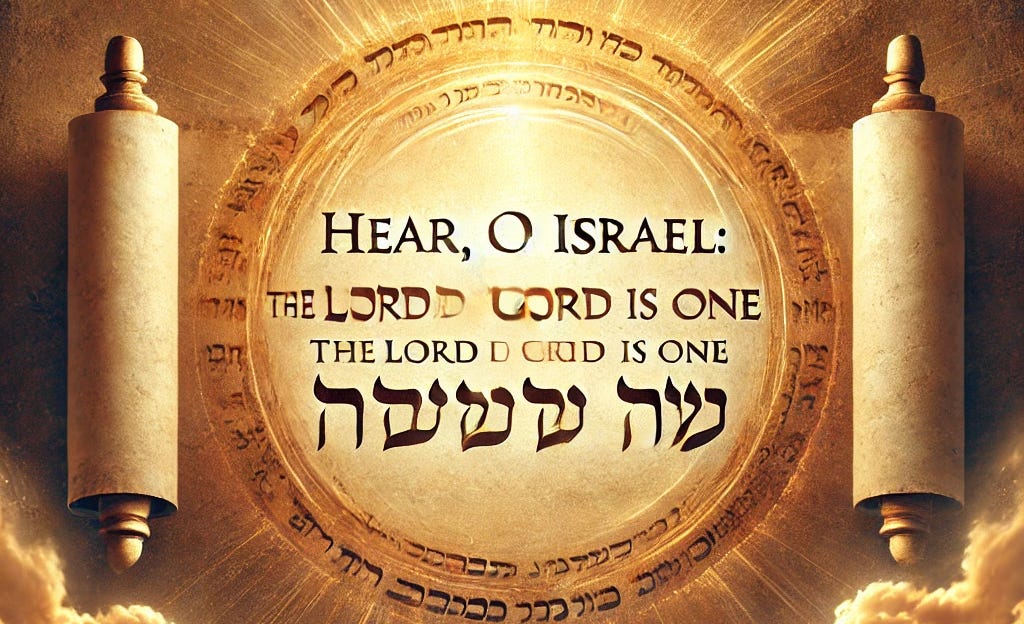
The Shema is a central prayer in Judaism and is considered one of the most important prayers in Jewish liturgy. It is recited twice daily by observant Jews and is a declaration of faith that affirms the belief in one God. The Shema's importance to Judaism lies in its affirmation of monotheism, the belief in one God, which is a core tenet of Judaism. The Shema is a call to love and serve God with all one's heart, soul, and might (strength), reflecting the importance of devotion to God in Judaism. The Shema also reminds Jews of their covenant with God, which is based on their faithfulness to God and the commandments.
“Hear, O Israel: The Lord our God, the Lord is one. Love the Lord your God with all your heart and with all your soul and with all your strength”. - Deuteronomy 6:4-6
In Leviticus we find: “Do not seek revenge or bear a grudge against anyone among your people, but love your neighbor as yourself. I am the Lord.” – Leviticus 19:18
In addition to its theological significance, the Shema also has practical importance in Jewish worship. It is recited twice daily, during the morning and evening prayers, and is also recited during other important Jewish rituals, such as the Passover seder. The Shema is also traditionally the last prayer recited before sleep, symbolizing the importance of faith in God as one's final thought before resting. The Shema is also a symbol of Jewish identity and serves as a unifying prayer for Jews around the world. Reciting the Shema connects Jews to their history, tradition, and community, and reinforces their faith in God and the commandments.
Jesus's quoting of the Shema is of great importance to Christianity as it reflects the importance of monotheism and the belief in one God in the Christian faith. Jesus affirms the Shema and quotes it as part of the greatest commandment, saying, "Hear, O Israel: The Lord our God, the Lord is one. Love the Lord your God with all your heart and with all your soul and with all your mind and with all your strength" - Mark 12:29-30. By quoting the Shema, Jesus reinforces the importance of the monotheistic belief in one God that is shared by Judaism, Christianity, and Islam (Quran, Surah: 112, 113, 114). This is significant as Christianity emerged from within a Jewish context, and Jesus himself was a Jewish teacher who emphasized the importance of the Jewish scriptures and traditions. Jesus’s quotation of the Shema also highlights the importance of loving God with one's whole being, which is a central teaching in Christianity. The commandment to love God with all one's heart, soul, mind, and strength is seen as the foundation of Christian ethics and is emphasized throughout the New Testament.
Furthermore, Jesus's quotation of the Shema demonstrates his continuity with Jewish tradition and his recognition of the importance of the Jewish scriptures. This highlights the continuity between Judaism and Christianity and reinforces the idea that Christianity did not emerge as a completely separate religion, but rather as a fulfillment and continuation of Jewish tradition.
There are some similarities and connections between the Shema and Christian beliefs. For example, both Christianity and Judaism share a belief in the God of Abraham, Isaac, and Jacob, who is the one and only God. In the New Testament, Jesus affirms the Shema and quotes it as part of the greatest commandment: “Love the Lord your God with all your heart and with all your soul and with all your mind. This is the first and greatest commandment. And the second is like it: Love your neighbor as yourself. All the Law and the Prophets hang on these two commandments.” - Matthew 22:37-40; Mark 12:28–34 Adding the love of others and of self as secondarily important. The comment that “All the Law and the Prophets hang on these two commandments” basically says that these two commandments are enough to describe the totality of our faith. Bishop Robert Baron has said that “…this may be the underlying principle to the whole Bible!”
Additionally, the Christian tradition includes the practice of reciting the Nicene Creed (which is a refinement of the much older Apostles Creed), which affirms the belief in one God, Father, Son, and Holy Spirit. This creed echoes the monotheistic belief of the Shema, but also reflects the Christian belief in the Trinity (One God in Three, Three as One).
The belief in one God, as affirmed in the Shema, is a core tenet of Judaism, Christianity, and Islam. The Abrahamic tradition, which is shared by these three religions, recognizes one God as the Creator and Sustainer of the universe. Moreover, the Shema is a call to love and serve God with all one's heart, soul, and might, reflecting the importance of devotion to God in Judaism. Similarly, both Christianity and Islam emphasize the importance of loving and serving God with one's whole being.
Jesus’s additional admonition to love our neighbor as ourselves basically wraps the ten commandments into two. For if we love God our Father with all of our heart, soul, mind, and strength and love our neighbors (brothers and sisters) as we love ourselves, we will not dare to violate any of the Ten Commandments.
The Didache also referred to as "The Teaching of the Twelve Apostles,", discovered in the late 19th century, is an early Christian document estimated to have been written during the late first century or early second century CE (80 AD – 120 AD). Although it was not included in the canon of the New Testament, the Didache offers valuable insights into the religious and ethical practices of the early Christian community. The Didache values the Schema and the Golden Rule so much it starts off with the following words on the first page: “Now the Way of Life is this: First, thou shalt love God who made thee. Secondly, thy neighbor as thyself, and all things whatsoever thou wouldst not have done to thee, neither do thou to another.” Through the first and second chapter it goes on to articulate all the many things that one must not do (basically from the Ten Commandments) in order to love one’s neighbor and oneself.
If we could only learn from our Prophets, our Lord Jesus Christ, and the early Christians who kept things very simple and understandable: ‘the Fatherhood of God, the brotherhood of man’. Keep that in mind as we work to perfect ourselves by loving God, loving our neighbors, loving ourselves. Do good and abstain from evil. Sound easy? Not so much! It is my hope that with some introspection we will all work on that. Remember, life is hard, God is good, don’t get the two mixed up.